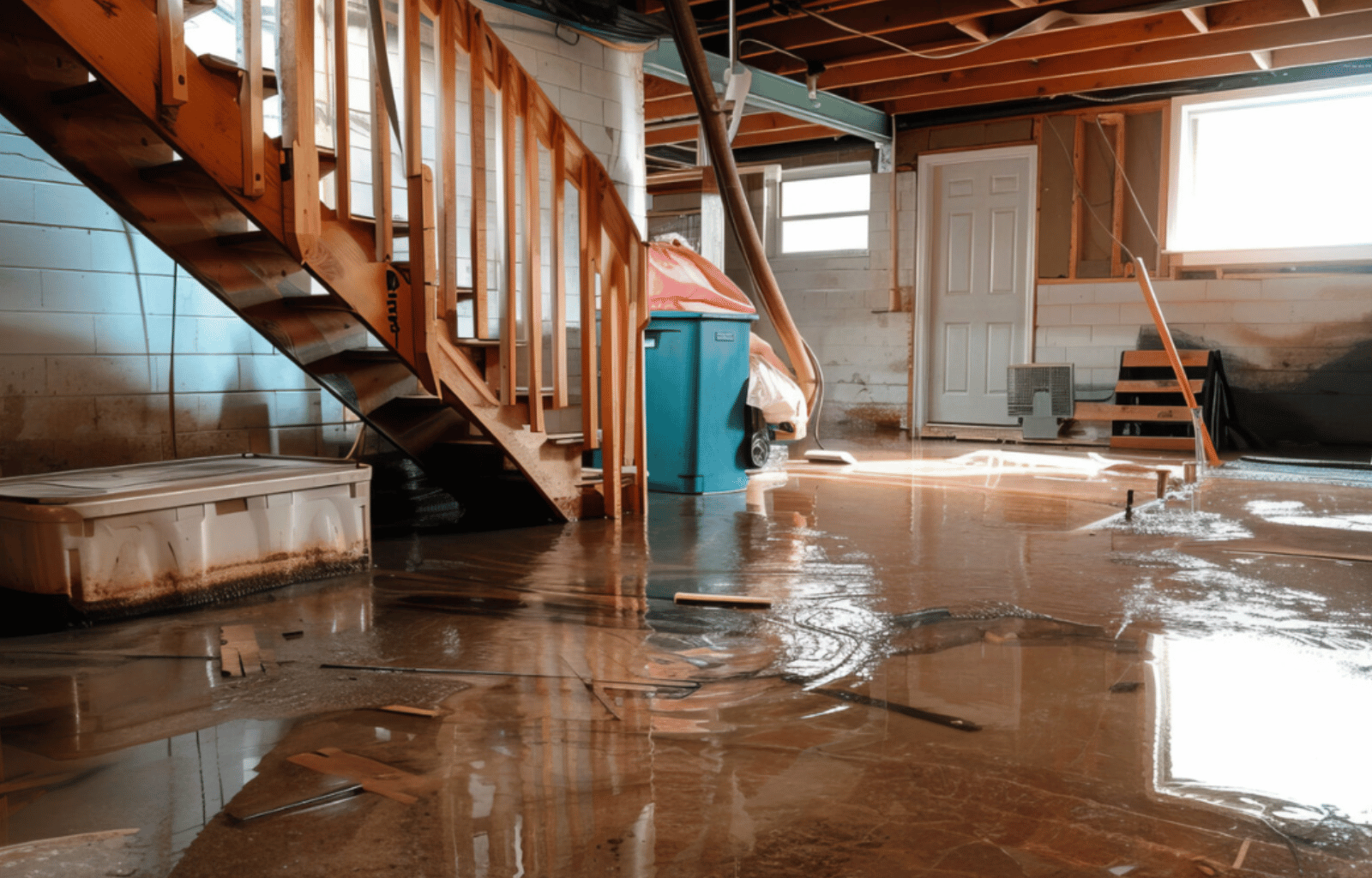


How Engineers Determine if Water-Damaged Structures Are Safe
After water enters a building — whether from a catastrophic flood, a burst pipe, a storm-driven roof leak, or years of slow infiltration — the question homeowners want answered is a simple one: is this structure safe?
The answer is rarely simple. Structural safety after water damage isn't a binary condition that engineers assess with a single test or a ten-minute walk-through. It's a judgment that emerges from a systematic investigation of multiple structural systems, interpreted through an understanding of how water damages materials over time, how loads move through a building, and how much capacity a structure must retain to be considered safe for its intended use.
What makes this particularly challenging is that water damage is deceptive. Structures that have been significantly compromised can appear normal to anyone without the tools, training, and methodology to look deeper. Structures that look alarming — staining, efflorescence, surface cracking — are sometimes structurally sound. The visible signs of water damage and the structural significance of water damage don't always correlate. This is precisely why a structural engineer's safety assessment is not a cosmetic inspection dressed up in technical language. It is a disciplined investigation with specific objectives and specific methods.
This guide explains how structural engineers approach safety determinations for water-damaged buildings: the framework they use, the methods they apply, the variables they weigh, and what their conclusions mean for the people who live and work in those buildings.
What "Structural Safety" Actually Means
Before explaining how engineers assess it, it's worth being precise about what structural safety means in this context — because the term is used loosely and misunderstood often.
A structure is considered structurally safe when it has adequate capacity to carry the loads it is expected to resist — dead loads (its own weight), live loads (occupants, contents, snow), wind loads, and in applicable regions, seismic loads — with a margin of reserve capacity beyond those expected loads. Building codes mandate specific safety factors: a structure isn't designed to carry exactly the loads it will experience; it's designed to carry those loads multiplied by a factor that accounts for variability in loads, variability in material properties, and the consequences of failure.
When water damage reduces structural capacity, it erodes that safety margin. The question the engineer must answer is: has enough capacity been lost that the structure can no longer be considered safe for its occupants and contents? Or does sufficient reserve remain that the structure can continue to be used while repairs are planned and executed?
This framing matters for a practical reason. A structure doesn't need to have lost all of its capacity to be unsafe — it only needs to have lost enough that the remaining capacity, under realistic loading conditions, falls below the minimum required margin. Conversely, a structure with visible water damage that has not affected load-carrying members may retain its full structural capacity and be perfectly safe to occupy. The engineer's job is to determine where a specific structure falls on that spectrum.
The Framework: Rapid Assessment Versus Detailed Evaluation
Not all structural safety assessments after water damage look the same. The appropriate scope depends on the nature of the water event, the time pressure involved, and the purpose of the assessment.
Rapid safety assessment. In the immediate aftermath of a significant water event — a major flood, a hurricane, a catastrophic pipe failure — the priority is determining whether a building can be occupied safely at all, and whether any conditions pose an immediate danger to the people entering it. Rapid assessments are performed quickly, often under difficult conditions, and result in a simple disposition: safe to occupy, restricted entry (specific areas or activities are restricted), or unsafe to enter.
Rapid assessments focus on the most critical structural elements and the most visible signs of compromise. They are not comprehensive structural evaluations — they're triage. A rapid assessment that clears a building for occupation is not a statement that the building has no water damage or will require no repairs. It is a statement that no immediately dangerous structural conditions were identified under the circumstances of the assessment.
Detailed structural evaluation. Once immediate safety is established and conditions allow, a detailed structural evaluation investigates the full extent of water damage to all structural systems. This is the assessment that produces actionable engineering recommendations for repair — the scope, methods, materials, and sequencing of remediation needed to restore full structural integrity. A detailed evaluation takes longer, requires more access, and may involve testing and investigation beyond what visual inspection alone can provide.
For most residential situations — a home that has flooded, a building with chronic moisture damage, a structure where water-related concerns have been identified by another professional — it's the detailed evaluation that homeowners need. Rapid assessments are more common in disaster response contexts where many buildings must be assessed quickly with limited engineering resources.
Step One: Understanding the Water Event and Its History
Every structural safety assessment for water damage begins with understanding the water itself — its source, its duration, its extent, and its history.
Source and mechanism. Groundwater flooding behaves differently from surface water flooding, which behaves differently from a roof leak, which behaves differently from a burst supply pipe. Groundwater carries dissolved minerals and can have chemical characteristics that affect concrete and steel. Surface water flooding can carry debris, contaminants, and sediment that affect structural surfaces and connections. A slow roof leak concentrates moisture in specific areas over time. A supply pipe failure delivers large volumes of clean water rapidly and may affect finished materials more than structural ones, depending on how quickly it was discovered and addressed.
The source determines which structural systems were exposed, how the water moved through the building, and what chemical or biological processes may have been set in motion.
Duration and saturation. How long structural elements were wet matters enormously. Wood framing that was wet for 24 hours and then dried quickly is in a fundamentally different condition than wood that has been wet for weeks or months. Concrete that experienced a single flooding event is different from concrete that has been subject to seasonal groundwater infiltration for a decade. Duration of exposure drives the degree of biological degradation (rot in wood), chemical processes (corrosion in steel, sulfate attack in concrete), and physical deterioration (freeze-thaw damage, erosion).
Extent of inundation. The height water reached in a structure determines which structural elements were submerged. Below-grade elements — foundations, basement slabs, below-grade wall sections — are almost always involved in basement flooding. Above-grade flooding from surface water or storm surge can affect floor systems, wall framing, and sometimes even roof structures. Understanding the water line allows the engineer to focus investigation on the systems that were actually exposed.
History of previous water events. A building experiencing its first significant water intrusion is structurally different from one that has flooded repeatedly over twenty years. Prior events may have caused damage that was repaired adequately, repaired inadequately, or not repaired at all. Hidden prior damage — deterioration behind finishes that was never addressed — can make a current event more structurally significant than it would otherwise appear.
Step Two: Systematic Investigation of Structural Systems
With the water history established, the engineer conducts a systematic investigation of the building's structural systems. The specific elements examined depend on the building type and the scope of water exposure, but for a typical residential structure, the investigation covers the following.
Foundation system. As discussed in depth in assessments of water-damaged foundations, the engineer examines foundation walls for cracking, bowing, displacement, and surface deterioration; footings for evidence of undermining, settlement, and bearing failure; and the slab for cracking and differential movement. In post-flood situations, the engineer also looks for evidence of scour — erosion of soil around and under footings caused by moving water during the flood event. Scour can undermine footings rapidly and severely, and its effects may not be immediately visible from inside the building.
Floor systems. Wood-framed floor systems — joists, beams, rim joists, sill plates — are among the most vulnerable elements in a flooded structure. The engineer assesses these members for moisture content (using a moisture meter), visible decay, staining that suggests prolonged saturation, and physical deterioration. Members that appear visually intact may have lost significant capacity if they remained wet long enough for decay to establish. The engineer probes suspected members with an awl or similar tool to assess the degree of decay below the surface.
Engineered wood products — I-joists, LVL beams, laminated lumber — behave differently than solid sawn lumber when wet. The adhesives in engineered wood can delaminate under prolonged saturation, separating the composite members into their component pieces and destroying the structural section. The engineer looks for delamination, swelling, and web buckling in I-joists, which are reliable indicators of water damage in engineered lumber.
Wall framing. Structural wall framing — load-bearing studs, top and bottom plates, headers over openings — is assessed for moisture content and decay. The engineer pays particular attention to bottom plates, which sit on the floor and accumulate moisture from below; to the framing around windows and door openings, where water concentrates; and to areas adjacent to exterior wall penetrations where water may have infiltrated from outside.
In shear wall systems — walls that resist lateral racking forces — the engineer also assesses the condition of the structural sheathing and its connections to the framing. Wet OSB sheathing swells, and the swelling can break fastener engagement with the framing, reducing shear capacity even before decay occurs.
Roof structure. Where the water event involved roof leaks or storm damage to the roof assembly, the engineer accesses the attic to assess rafter and truss conditions, ridge board or ridge beam integrity, and the condition of roof sheathing. Leaks that have been occurring for months or years may have produced significant decay in rafters, particularly at their ends where they bear on the wall plates, and in the sheathing near valleys, penetrations, and perimeter edges where water concentrates.
Connections and fasteners. Structural connections — joist hangers, hurricane ties, hold-downs, anchor bolts, and the nails and bolts that fasten structural members together — are often the most vulnerable elements in a water-damaged structure. Metal connectors corrode. Corrosion reduces the cross-section of metal elements and can cause brittle failure in connectors designed to be ductile. The engineer examines critical connections for corrosion, assessing whether reduced connector capacity has meaningfully affected the structure's ability to transfer loads.
Step Three: Interpreting the Evidence
Gathering observations is necessary but not sufficient. The engineer must interpret what the observations mean for structural safety — a step that requires both technical knowledge and professional judgment.
Distinguishing cosmetic damage from structural damage. Staining, efflorescence, surface scaling, and discolouration are the most visible consequences of water damage, and they are often the least structurally significant. A concrete foundation wall with extensive efflorescence is telling the engineer that water has been moving through the wall — that's useful information about drainage conditions — but the efflorescence itself doesn't reduce structural capacity. Conversely, a floor joist with only minor surface staining may have been wet long enough at its core to have lost substantial capacity to decay. The engineer's job is to look past the visible and assess the actual structural condition.
Assessing residual capacity. When structural members have been damaged — by decay, corrosion, or physical deterioration — the engineer estimates the residual capacity of those members: how much load-carrying ability they retain. This is not always a precise calculation; it often involves judgment based on the extent of section loss observed during probing, the member's original size and species, and its position in the load path. The engineer compares this estimated residual capacity to the loads the member must carry, with the appropriate safety factors, to determine whether the member is adequate in its current condition.
Understanding load path implications. A single damaged member may or may not create a safety concern, depending on where it sits in the structure's load path. A rotted rim joist carries the ends of floor joists and transfers gravity loads to the foundation; its failure could affect a significant portion of the floor system. A rotted non-structural filler stud in a non-load-bearing partition carries nothing and poses no structural safety concern. The engineer traces the load path to understand the structural significance of each damaged element — which ones are critical, which are secondary, and which are irrelevant to structural safety.
Evaluating redundancy. Well-designed structures have redundancy: if one element fails, loads can redistribute to adjacent members rather than causing progressive collapse. The degree of redundancy affects how seriously a damaged member compromises overall safety. A single rotted joist in a floor with many joists at close spacing may allow significant load redistribution to adjacent sound members; the floor may deflect locally but not fail. A single damaged beam supporting a large tributary area with no alternative load path is a much more critical concern.
Considering time and progression. Some forms of water damage are static — a one-time event that caused damage, now dried and not progressing. Others are dynamic — active moisture conditions continuing to cause ongoing deterioration. The engineer distinguishes between these conditions because they have different implications for urgency. A structure with active, ongoing moisture infiltration is deteriorating as the assessment is being performed; recommendations need to address both the current state and the trajectory. A structure that has been thoroughly dried and where the water source has been eliminated is in a fixed state that can be assessed and remediated on a deliberate timeline.
Step Four: The Safety Determination
With investigation complete and evidence interpreted, the engineer makes the safety determination. This determination is not a checkbox — it is a professional judgment communicated in a written report that explains the basis for the conclusion and provides a clear path forward.
Safe to occupy without restriction. Water damage has been identified, but it has not compromised structural capacity to a degree that creates safety concern. Repairs are recommended but not urgently required for safety; they address durability, future moisture management, or code compliance rather than immediate structural adequacy.
Safe to occupy with restrictions. Structural capacity has been reduced in specific areas or under specific loading conditions, but the overall structure is not imminently unsafe. Restrictions might include avoiding heavy concentrated loads in specific areas, limiting occupancy of a particular floor, or prohibiting certain uses until repairs are completed. The engineer specifies the restrictions clearly and explains the structural basis for each.
Unsafe to occupy — repairs required before re-entry. Structural capacity has been reduced below the level required for safe occupation, or conditions exist that could lead to sudden, unpredicted failure under realistic loading conditions. The building must not be occupied until specified structural repairs are completed and re-evaluated.
Immediate danger — vacate and shore. In extreme cases, the engineer may determine that failure is imminent or that certain elements could fail without warning under any significant loading. Emergency shoring, immediate evacuation, and urgent structural intervention are required.
The Role of Testing
Visual inspection and probing are the primary investigation tools, but some situations call for material testing to supplement what can be observed directly.
Moisture content measurement. Moisture meters provide quantitative data on the moisture content of wood framing — data that supports decisions about whether members need replacement, whether the building has dried adequately for repairs to proceed, and whether ongoing moisture sources remain active.
Concrete core sampling. When the strength of existing concrete is in question — because of age, visible deterioration, or suspected poor original construction — core samples can be extracted and tested to determine actual compressive strength. This is particularly valuable when the original concrete mix design is unknown and the visual condition suggests potential weakness.
Rebar assessment. Half-cell potential testing uses electrochemical measurements to assess the probability of active rebar corrosion in reinforced concrete — useful when the exterior evidence suggests corrosion activity but the rebar itself is not yet visible. Ground-penetrating radar can locate rebar and identify areas of delamination without breaking the concrete surface.
Load testing. In unusual situations where analytical methods cannot resolve uncertainty about a floor or structural element's capacity, a carefully controlled load test — applying known loads and measuring deflection — can provide direct evidence of in-place capacity. This is rare in residential contexts but occasionally appropriate.
After the Assessment: What Comes Next
A structural safety assessment for water damage is not the end of the process — it is the beginning of an informed remediation. The engineer's report documents what was found, what it means for safety, and what must be done to restore full structural integrity. It provides the basis for the building permit, the contractor scope, and the sequenced repair plan.
Homeowners should understand that a safety determination — even one that clears a building for occupancy — does not mean that no action is needed. Structural safety and structural adequacy for the long term are related but not identical. A structure can be safe to occupy today while having damage that will worsen over time if not addressed. The engineer's report will distinguish between what is needed now and what can be addressed on a planned timeline — and homeowners should take both seriously.
Final Thoughts
Water damage is invisible until it isn't — and by the time it becomes visible, the structural consequences may have been accumulating for months or years. An engineer's safety assessment is what converts uncertainty into knowledge: it tells homeowners and building owners what has actually happened to their structure, what it means, and what needs to be done.
That knowledge is the foundation for every decision that follows — whether to repair or replace, when to act, what to spend, and whether it's safe to sleep in the house tonight. It is the most important professional service available in the aftermath of a water event, and it is the one that too many homeowners delay in favour of faster, cheaper, and ultimately less reliable alternatives.
If your building has experienced significant water damage, get a structural engineer involved early. The assessment costs a fraction of the repair it informs — and a fraction of the cost of getting the repairs wrong.
Dealing with water damage and unsure whether your home is structurally safe? A licensed structural engineer can assess your building and give you a clear, documented answer — along with a specific plan for what needs to happen next.
Easy steps to create a color palette
Lorem ipsum dolor sit amet, consectetur adipiscing elit lobortis arcu enim urna adipiscing praesent velit viverra sit semper lorem eu cursus vel hendrerit elementum morbi curabitur etiam nibh justo, lorem aliquet donec sed sit mi dignissim at ante massa mattis.
- Neque sodales ut etiam sit amet nisl purus non tellus orci ac auctor
- Adipiscing elit ut aliquam purus sit amet viverra suspendisse potent
- Mauris commodo quis imperdiet massa tincidunt nunc pulvinar
- Excepteur sint occaecat cupidatat non proident sunt in culpa qui officia
What is a color palette?
Vitae congue eu consequat ac felis placerat vestibulum lectus mauris ultrices cursus sit amet dictum sit amet justo donec enim diam porttitor lacus luctus accumsan tortor posuere praesent tristique magna sit amet purus gravida quis blandit turpis.

Don’t overspend on growth marketing without good retention rates
At risus viverra adipiscing at in tellus integer feugiat nisl pretium fusce id velit ut tortor sagittis orci a scelerisque purus semper eget at lectus urna duis convallis porta nibh venenatis cras sed felis eget neque laoreet suspendisse interdum consectetur libero id faucibus nisl donec pretium vulputate sapien nec sagittis aliquam nunc lobortis mattis aliquam faucibus purus in.
- Neque sodales ut etiam sit amet nisl purus non tellus orci ac auctor
- Adipiscing elit ut aliquam purus sit amet viverra suspendisse potenti
- Mauris commodo quis imperdiet massa tincidunt nunc pulvinar
- Adipiscing elit ut aliquam purus sit amet viverra suspendisse potenti
What’s the ideal customer retention rate?
Nisi quis eleifend quam adipiscing vitae aliquet bibendum enim facilisis gravida neque euismod in pellentesque massa placerat volutpat lacus laoreet non curabitur gravida odio aenean sed adipiscing diam donec adipiscing tristique risus amet est placerat in egestas erat.
“Lorem ipsum dolor sit amet consectetur adipiscing elit, sed do eiusmod tempor incididunt ut labore et dolore magna aliqua enim ad minim veniam.”
Next steps to increase your customer retention
Eget lorem dolor sed viverra ipsum nunc aliquet bibendum felis donec et odio pellentesque diam volutpat commodo sed egestas aliquam sem fringilla ut morbi tincidunt augue interdum velit euismod eu tincidunt tortor aliquam nulla facilisi aenean sed adipiscing diam donec adipiscing ut lectus arcu bibendum at varius vel pharetra nibh venenatis cras sed felis eget.