
Water Mitigation and Restoration Explained
Water mitigation and water restoration are two distinct phases of recovery after water damage in a Scottsdale, AZ home. Mitigation is the emergency phase: it stops the damage from spreading and creates conditions for safe drying. Restoration is the repair phase: it returns the property to its pre-loss condition. Mitigation always comes first. Without complete mitigation — including verified drying — restoration work will fail because it rebuilds over materials that are still wet. Most insurance policies cover both phases, though they may be handled separately in the claims process.
Key Takeaways
- Mitigation is the emergency phase: water extraction, drying, demolition of unsalvageable material, and mold prevention.
- Restoration is the repair phase: drywall, flooring, painting, cabinetry, and any structural repairs.
- The order is non-negotiable: restoration cannot begin until mitigation is complete and drying is verified.
- Both phases are typically covered by homeowners insurance for covered water damage events.
- Insurance adjusters may handle mitigation and restoration as separate line items in the claim.
- A company that handles both phases provides continuity and reduces delays.
Table of Contents
- What Is Water Mitigation?
- What Is Water Restoration?
- How the Two Phases Interact
- Why This Matters in Scottsdale, AZ
- Insurance and the Two-Phase Process
- What To Do Next
- When To Call a Professional
- FAQ
What Is Water Mitigation?
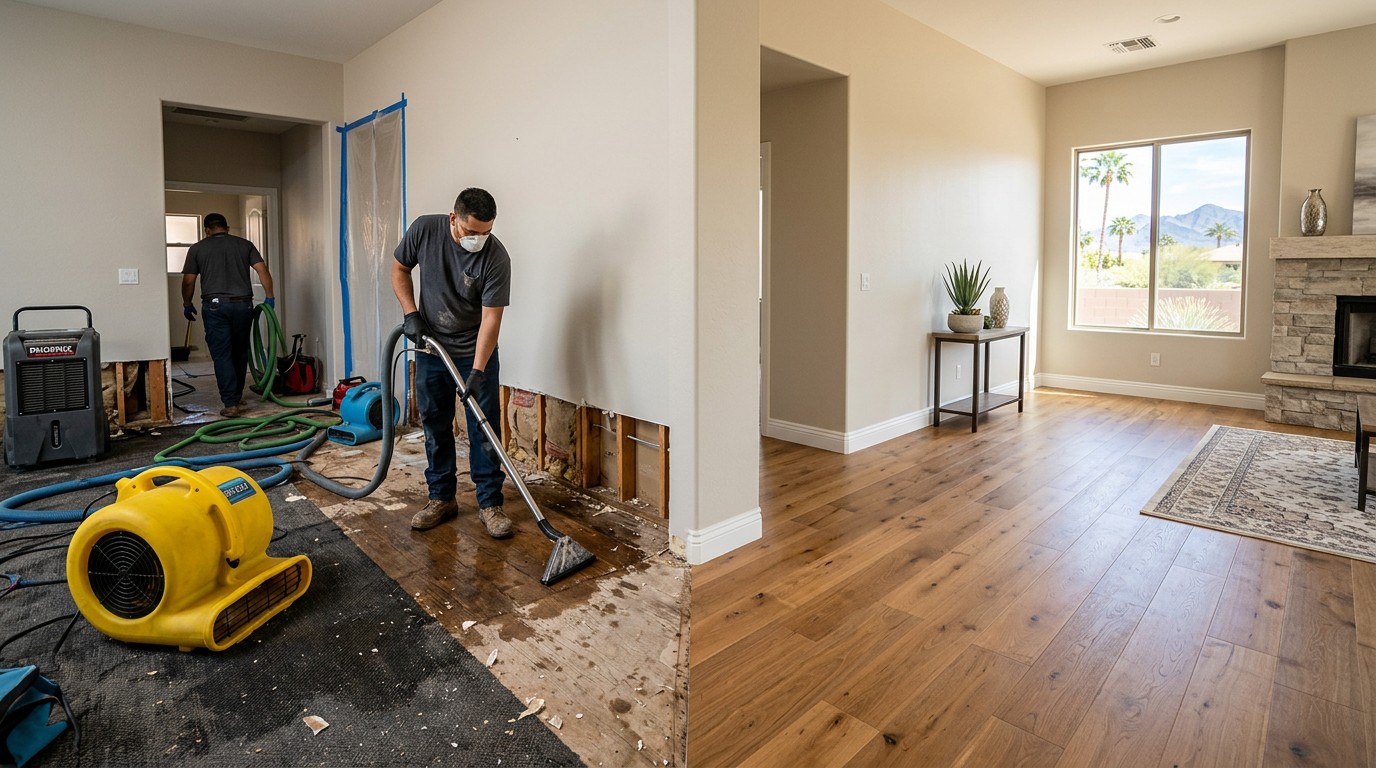
Water damage mitigation is the emergency response phase. Its goal is to stop the damage from getting worse and to create the safest, driest possible conditions for restoration. Mitigation activities include:
Emergency water extraction — Industrial extractors remove all standing and absorbed water from floors, carpets, and structural cavities. See Water Extraction.
Moisture mapping and assessment — Thermal imaging and moisture meters establish the full extent of water migration before any drying equipment is placed.
Structural drying — Commercial air movers and dehumidifiers are engineered into a drying system targeting specific affected materials. See Dehumidification and Drying.
Selective demolition — Drywall, flooring, insulation, and other materials that cannot be dried in place are removed. This controlled demolition exposes framing for effective drying and prevents mold from establishing inside enclosed assemblies.
Mold prevention treatments — Antimicrobial applications to at-risk surfaces after extraction and before enclosure.
Documentation — Damage documentation, moisture readings, and daily drying logs prepared for insurance carrier submission.
Mitigation is complete when all affected materials have been verified dry to industry-standard moisture content levels. Only then is the property ready for restoration.
What Is Water Restoration?
Water damage restoration is the rebuilding phase. It begins only after mitigation is fully complete and verified. Restoration activities include:
Drywall repair and replacement — New drywall is hung, taped, and finished to match existing surfaces. Texture matching in Scottsdale homes — which commonly feature knockdown, skip-trowel, or smooth finishes — requires skilled technicians.
Flooring reinstallation — Hardwood, tile, carpet, or vinyl plank is reinstalled based on what was removed during mitigation and what survived.
Painting — Affected rooms are repainted to match existing finishes.
Cabinetry and millwork repair — Water-damaged cabinets, trim, and built-ins are repaired or replaced.
Structural repairs — If water damage compromised framing, subfloor, or other structural elements, repairs are performed by licensed contractors as part of the restoration scope.
Final inspection — A walkthrough confirms the property is returned to pre-loss condition, and all work is documented for the insurance carrier and homeowner.
How the Two Phases Interact
The relationship between mitigation and restoration is sequential and dependent.
Water Event → Emergency Mitigation → Verified Drying → Restoration → Pre-Loss Condition
A common mistake is attempting restoration before mitigation is truly complete. Painting over wet drywall traps moisture. Laying new flooring over unverified subfloor creates a mold chamber. Rebuilding over wet framing initiates decay. This is why verified moisture readings — not visual inspection or "feel" — must confirm dryness before any restoration work begins.
In Scottsdale, this is particularly important because surfaces dry rapidly on the face while moisture persists inside. A technician who relies on visual inspection rather than moisture meter verification may incorrectly clear the area for restoration, resulting in mold behind the new walls weeks later.
Why This Matters in Scottsdale, AZ
Two-Phase Work Protects Scottsdale's High-Value Finishes
Scottsdale homes frequently feature high-end materials: travertine and marble tile, custom cabinetry, specialty wall finishes, and designer flooring. The mitigation phase determines how much of these finishes must be removed versus dried in place. A skilled mitigation team that maximizes in-place drying reduces the scope and cost of the restoration phase significantly.
The Desert Climate Creates Verification Challenges
As discussed throughout this blog, Scottsdale's heat dries surfaces rapidly. A restoration contractor who enters an area after mitigation and judges it "ready" by sight and feel may be wrong. The restoration phase in Scottsdale should always begin with final moisture verification readings — not assumptions.
Insurance Adjusters Distinguish the Two Phases
Insurance carriers typically review mitigation and restoration as separate line items. Mitigation costs (extraction, drying equipment, selective demolition, documentation) are generally treated as emergency services and approved quickly. Restoration estimates (materials, labor for rebuild) go through a more detailed review process. Working with a company that handles insurance support and understands how to document both phases appropriately streamlines both approvals.
Insurance and the Two-Phase Process
For covered water damage events, most homeowners insurance policies cover both mitigation and restoration. The key distinction:
- Mitigation costs are generally approved without detailed review as emergency measures to prevent further damage. Authorize and begin immediately.
- Restoration costs typically require a detailed scope and adjuster review before approval. Do not begin restoration work until you have authorization.
Your restoration company should provide a written estimate for both phases and communicate with your adjuster throughout the process. Scottsdale Water Damage Restoration handles direct insurance billing and adjuster communication for both phases of the project.
For a full guide to the insurance claim process, see Does Homeowners Insurance Cover Water Damage in Scottsdale, AZ?.
What To Do Next
After a water damage event in Scottsdale:
- Call immediately for emergency mitigation. The sooner mitigation begins, the less there is to restore.
- Ask your restoration company for a written two-phase scope — one for mitigation and one for restoration — so you and your insurance carrier understand what is included in each phase and when each begins.
- Do not authorize any restoration work until you have seen the final verified moisture readings from the mitigation phase.
- Communicate with your insurance carrier about both phases; do not assume restoration is automatically authorized.
For related information on the professional drying process within mitigation, see How Do Professionals Dry Out a House After Water Damage in Scottsdale, AZ?.
When To Call a Professional
Call immediately after any water damage event. The sooner mitigation begins, the smaller the restoration scope will be. A company that handles both phases provides continuity of documentation, single-point insurance communication, and no gap between when mitigation ends and restoration can begin.
Water damage remediation in Scottsdale requires professionals who understand both the emergency and rebuild phases, and how to sequence them correctly in the desert climate.
FAQ
Q: Which costs more — mitigation or restoration? It depends entirely on the scope. For smaller events where materials can be dried in place, mitigation may be the larger cost. For larger events requiring significant demolition and rebuild, restoration often exceeds mitigation. Both are typically covered by homeowners insurance for covered events.
Q: Can I use a different company for mitigation and restoration? Yes, though it creates handoff complexity. The mitigation company's drying logs, moisture readings, and scope documentation are critical inputs for the restoration estimate. Using the same company for both phases — or ensuring clean documentation transfer — produces smoother project execution.
Q: How long is the gap between mitigation and restoration? In a standard residential event, drying typically takes 3 to 5 days. After verified dryness, restoration can begin immediately. For larger events with extensive demolition and rebuild, restoration timelines can range from days to several weeks depending on material availability and scope.
Q: Is mold remediation part of mitigation or restoration? Mold remediation is typically treated as a separate project category, though it occurs during the mitigation phase (before restoration). If mold is present, the remediation must be completed and verified before restoration begins.
Q: Does my homeowners insurance cover both phases? For covered water damage events, most standard homeowners policies cover emergency mitigation and the cost to restore the property to pre-loss condition, including materials and labor. Policy details vary — review your policy and work with an insurer-familiar restoration company.
Q: What is water damage remediation — is it different from restoration? Water damage remediation is a broader term that can encompass the full scope of addressing and reversing water damage — including both the mitigation and restoration phases. It is sometimes used specifically to refer to mold removal. Terminology varies by company and region.
Get Help Now — We Arrive in 25 Minutes
From emergency extraction to full property restoration, Scottsdale Water Damage Restoration handles both phases of your project under one roof, with direct insurance billing and 24/7 availability.
Call (623) 300-0841 — Available 24/7
Or Request a Quote Online
---
Easy steps to create a color palette
Lorem ipsum dolor sit amet, consectetur adipiscing elit lobortis arcu enim urna adipiscing praesent velit viverra sit semper lorem eu cursus vel hendrerit elementum morbi curabitur etiam nibh justo, lorem aliquet donec sed sit mi dignissim at ante massa mattis.
- Neque sodales ut etiam sit amet nisl purus non tellus orci ac auctor
- Adipiscing elit ut aliquam purus sit amet viverra suspendisse potent
- Mauris commodo quis imperdiet massa tincidunt nunc pulvinar
- Excepteur sint occaecat cupidatat non proident sunt in culpa qui officia
What is a color palette?
Vitae congue eu consequat ac felis placerat vestibulum lectus mauris ultrices cursus sit amet dictum sit amet justo donec enim diam porttitor lacus luctus accumsan tortor posuere praesent tristique magna sit amet purus gravida quis blandit turpis.

Don’t overspend on growth marketing without good retention rates
At risus viverra adipiscing at in tellus integer feugiat nisl pretium fusce id velit ut tortor sagittis orci a scelerisque purus semper eget at lectus urna duis convallis porta nibh venenatis cras sed felis eget neque laoreet suspendisse interdum consectetur libero id faucibus nisl donec pretium vulputate sapien nec sagittis aliquam nunc lobortis mattis aliquam faucibus purus in.
- Neque sodales ut etiam sit amet nisl purus non tellus orci ac auctor
- Adipiscing elit ut aliquam purus sit amet viverra suspendisse potenti
- Mauris commodo quis imperdiet massa tincidunt nunc pulvinar
- Adipiscing elit ut aliquam purus sit amet viverra suspendisse potenti
What’s the ideal customer retention rate?
Nisi quis eleifend quam adipiscing vitae aliquet bibendum enim facilisis gravida neque euismod in pellentesque massa placerat volutpat lacus laoreet non curabitur gravida odio aenean sed adipiscing diam donec adipiscing tristique risus amet est placerat in egestas erat.
“Lorem ipsum dolor sit amet consectetur adipiscing elit, sed do eiusmod tempor incididunt ut labore et dolore magna aliqua enim ad minim veniam.”
Next steps to increase your customer retention
Eget lorem dolor sed viverra ipsum nunc aliquet bibendum felis donec et odio pellentesque diam volutpat commodo sed egestas aliquam sem fringilla ut morbi tincidunt augue interdum velit euismod eu tincidunt tortor aliquam nulla facilisi aenean sed adipiscing diam donec adipiscing ut lectus arcu bibendum at varius vel pharetra nibh venenatis cras sed felis eget.