
How Professional Structural Drying Works
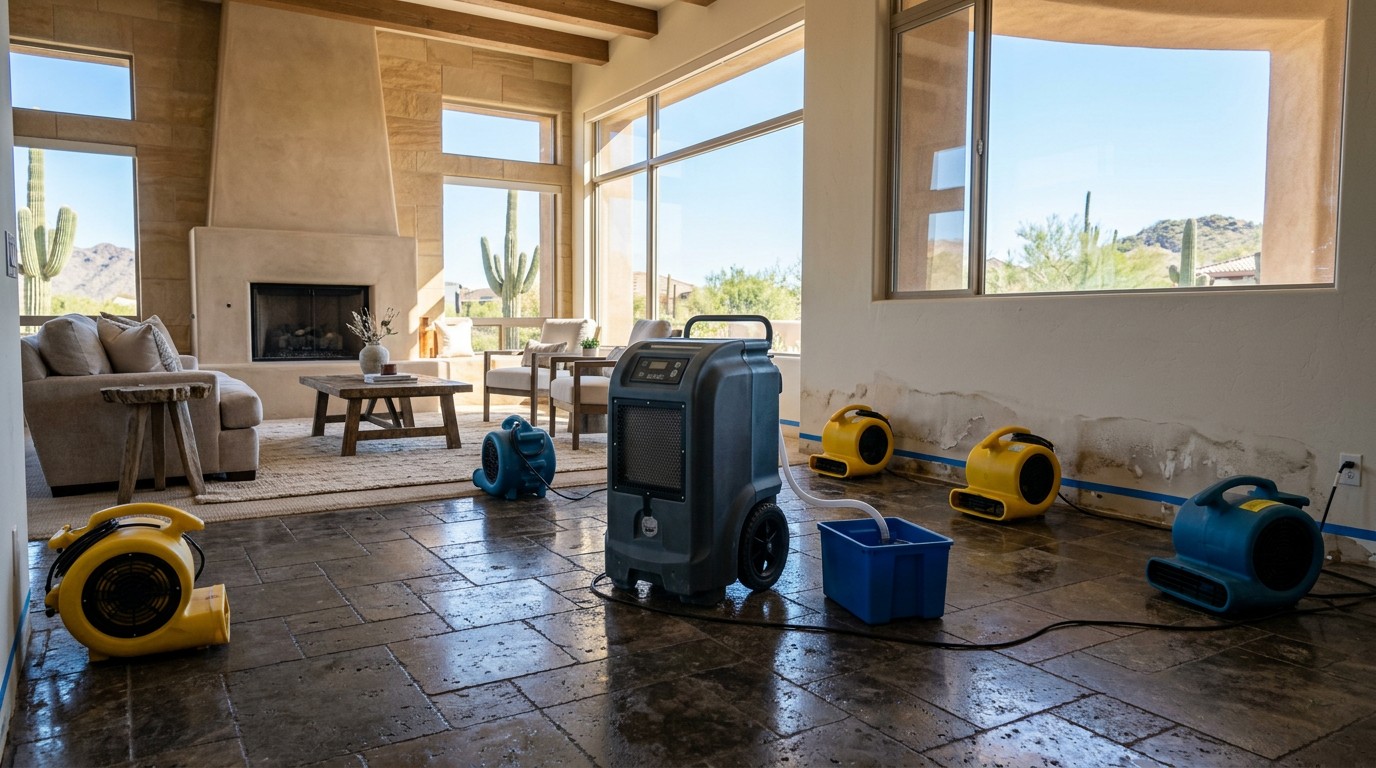
Professional water damage drying in Scottsdale, AZ follows a precise, equipment-intensive process. After extracting all standing water with industrial-grade equipment, certified technicians establish a drying system using commercial air movers, dehumidifiers, and in some cases, drying panels and floor mats targeting specific structural materials. Moisture readings are taken daily at defined measurement points, and equipment is adjusted until all materials reach industry-standard dry levels. This process is fundamentally different from running household fans — it actively removes moisture from inside walls, subfloor, and structural framing that household equipment cannot reach.
Key Takeaways
- Professional water extraction removes 10 to 40 times more water per hour than consumer wet-dry vacuums.
- Commercial drying equipment creates controlled airflow inside wall cavities — household fans push surface air only.
- Daily moisture readings track progress at defined points and verify drying is complete before equipment is removed.
- In Scottsdale's climate, the drying process typically takes 3 to 5 days for standard residential events; larger or more complex situations take longer.
- Drying is verified, not assumed — materials must reach target moisture readings before enclosure.
- The goal is to dry materials in place wherever possible, avoiding unnecessary demolition.
Table of Contents
- Step 1: Assessment and Moisture Mapping
- Step 2: Water Extraction
- Step 3: Structural Drying Setup
- Step 4: Daily Monitoring and Adjustment
- Step 5: Verification and Equipment Removal
- Why This Happens in Scottsdale, AZ
- What To Do Next
- When To Call a Professional
- FAQ
Step 1: Assessment and Moisture Mapping
Before any equipment is placed, a certified technician performs a full assessment using calibrated moisture meters and, for complex situations, thermal imaging. This maps every affected area — including surfaces that appear dry but contain elevated moisture — and establishes a baseline for tracking drying progress.
Moisture mapping identifies the full extent of water migration, including inside wall cavities, under flooring, and in ceilings. Without this step, drying equipment is placed by guesswork, and concealed moisture zones are missed entirely.
The assessment also categorizes the water by contamination level — clean water (Category 1), gray water (Category 2), or black water (Category 3) — because contamination level determines required protocols for materials handling and personal protective equipment.
Step 2: Water Extraction
Water extraction uses truck-mounted or portable industrial extractors that move hundreds of gallons of water per hour. These units create suction levels far beyond any consumer wet-dry vacuum, pulling moisture from carpet, pad, and hard flooring materials effectively.
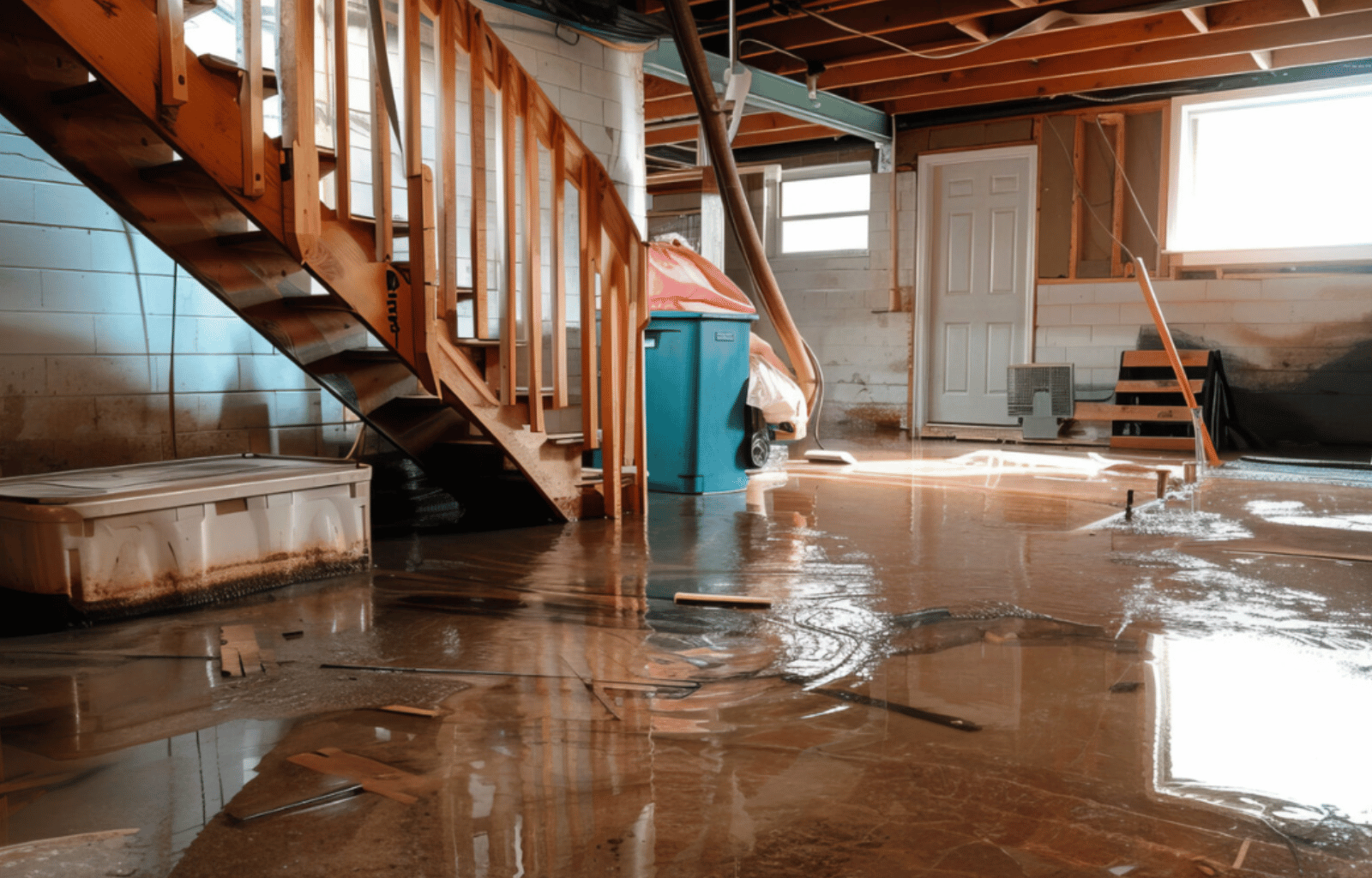
For standing water in flooded rooms or basements, submersible pumps may be deployed first to remove bulk water before extractors complete the job. See Flooded Basement Cleanup for basement-specific procedures.
In Scottsdale homes with hardwood flooring — common in luxury builds — extraction is often combined with in-place drying mat systems that draw moisture through the face of the flooring, sometimes avoiding full replacement.
Step 3: Structural Drying Setup
After extraction, the drying system is engineered and installed. This is not simply placing fans in corners. A calibrated drying system requires:
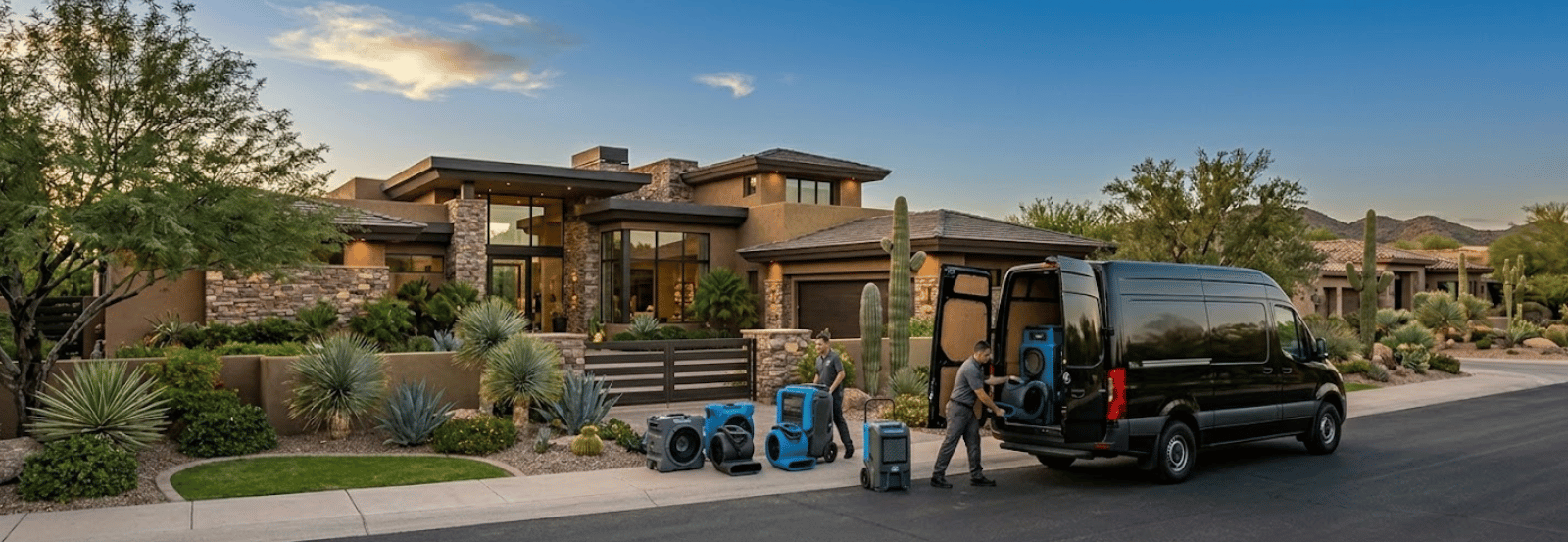
Air Movers (High-Velocity Fans) Positioned at specific angles to create a vortex of airflow across wet surfaces, moving evaporated moisture toward dehumidifiers. The number, placement, and angle are calculated based on room geometry and measured moisture levels.
Commercial Dehumidifiers Capture the moisture-laden air created by air movers and condense it to liquid for removal. Commercial dehumidifiers remove significantly more moisture per day than residential units. In large or heavily saturated areas, multiple units are staged throughout the drying zone.
Drying Panels (Wall and Cavity Drying) For moisture inside wall cavities, technicians may install drying panels — sealed systems that direct heated, dry air into the wall cavity through small access holes — avoiding the need to remove large sections of drywall. This is a significant cost-saver in Scottsdale homes with high-end wall finishes.
Floor Drying Systems Hardwood and engineered wood floors can sometimes be saved using specialized drying mats that draw moisture out from below, maintaining the floor's geometry while drying occurs.
For large commercial properties, see Commercial Structural Drying for additional scope and protocols.
Step 4: Daily Monitoring and Adjustment
A properly managed drying project includes daily or twice-daily moisture readings at all baseline measurement points. Technicians record readings, compare to the prior day, and adjust equipment as needed — repositioning air movers, adding or removing dehumidifiers, and opening or sealing rooms to manage airflow.
Documentation from daily monitoring serves dual purposes: it verifies the work is progressing and provides the insurance carrier with the objective drying records required for claim documentation.
In Scottsdale, summer heat can interfere with drying system efficiency because outdoor air feeding HVAC systems is extremely hot and dry. Technicians account for this in equipment selection and may use independent drying circuits rather than relying on the home's HVAC during active drying.
Step 5: Verification and Equipment Removal
Drying is complete only when all affected materials reach the target moisture content levels established for that material category — not when things "feel dry" or "look dry." Verified dryness is documented with final moisture readings at all measurement points.
Only after verified dryness is confirmed do technicians remove equipment and clear the area for restoration work: drywall repair, painting, flooring reinstallation, and finish carpentry. Skipping verification — or relying on visual inspection alone — is the single most common cause of post-restoration mold problems.
For what happens after drying is complete, see What Is the Difference Between Water Mitigation and Water Restoration in Scottsdale, AZ?.
Why This Happens in Scottsdale, AZ
Scottsdale's desert climate creates specific challenges for professional drying operations that technicians account for in every project.
Deceptive Surface Drying Scottsdale's low ambient humidity means surfaces — floors, drywall faces, trim — may appear and feel completely dry within 24 hours even when wall cavities and subfloor assemblies are still significantly wet. This can lead homeowners and inexperienced contractors to stop drying too early, leaving concealed moisture that produces mold and structural damage weeks later.
Extreme Summer Heat In summer months, Scottsdale outdoor temperatures regularly exceed 110°F. This extreme heat affects equipment performance and may require equipment adjustments. It also means that any delay in starting professional drying creates a more aggressive mold-growth environment than in cooler regions.
Flat Roof Construction Scottsdale luxury homes frequently feature large flat or low-slope roof areas that, when compromised during a monsoon storm, can admit significant water volume into attic spaces and ceiling assemblies. Drying these multi-layer assemblies requires specialized equipment positioning and often extended drying timelines.
What To Do Next
- If water damage is active or recent, call for emergency response before attempting any independent drying.
- Ask your restoration company for a written drying plan including baseline moisture readings, target levels, and estimated timeline.
- Request daily logs of moisture readings — these are important for your insurance claim.
- Do not authorize enclosure (drywall reinstallation, flooring, painting) until you have seen the final verified dry readings.
For a complete understanding of what follows drying, see What Is the Difference Between Water Mitigation and Water Restoration in Scottsdale, AZ?.
When To Call a Professional
Any water event that has affected structural materials — walls, flooring, subfloor, ceilings — requires professional drying equipment and expertise. Consumer equipment and household fans do not reach moisture inside structural assemblies. The apparent cost savings of DIY drying consistently result in higher total costs when concealed mold is discovered weeks or months later.
Call Scottsdale Water Damage Restoration for professional drying setup that begins within hours of your call.
FAQ
Q: How long does it take to dry out a house after water damage in Scottsdale? For a standard residential event affecting one to two rooms, professional drying typically takes 3 to 5 days with properly sized and positioned equipment. Larger events, slab moisture, or complex assemblies (custom cabinetry, multi-layer flooring) may extend timelines. Your technician can provide an estimated range after the initial moisture assessment.
Q: Can I run the heat in my home to help dry it out after water damage? Running your HVAC is generally not recommended during active water damage drying. HVAC systems are not designed to manage the moisture loads of a water damage event and may spread moisture to unaffected areas. Professional drying systems operate independently of your HVAC.
Q: Why do technicians remove sections of drywall if the goal is to dry without demolition? Severely saturated drywall — particularly paper-faced gypsum that has been wet for more than 24 to 48 hours — cannot be dried reliably and should be removed to expose the framing behind it for effective drying. Drywall is inexpensive to replace; the framing, insulation, and finish behind it are the priority.
Q: What is the difference between a commercial dehumidifier and a residential one? Commercial dehumidifiers used in professional restoration are rated to remove many times more moisture per day than residential units. They are also engineered for continuous high-humidity environments and can operate across a wider temperature range. Residential dehumidifiers are not capable of structural drying.
Q: Will I need to leave my home during the drying process? For most standard residential water damage events, you do not need to vacate the home. Equipment is loud, and affected areas are inaccessible, but most families can continue living in unaffected portions of the home. If the event involved contaminated water, sewage, or large-scale mold, temporary relocation may be recommended.
Q: Does insurance cover the cost of professional drying equipment? Yes — emergency mitigation services, including professional drying, are typically covered under the mitigation provisions of a standard homeowners policy. Insurers expect and accept this expense as preventing additional (more expensive) structural damage. Your restoration company handles direct insurance billing.
Get Help Now — We Arrive in 25 Minutes
Professional drying that starts sooner means less damage, lower costs, and no hidden mold months later. Our team deploys industrial drying systems across Scottsdale 24 hours a day, 7 days a week.
Call (623) 300-0841 — Available 24/7
Or Request a Quote Online
---
Easy steps to create a color palette
Lorem ipsum dolor sit amet, consectetur adipiscing elit lobortis arcu enim urna adipiscing praesent velit viverra sit semper lorem eu cursus vel hendrerit elementum morbi curabitur etiam nibh justo, lorem aliquet donec sed sit mi dignissim at ante massa mattis.
- Neque sodales ut etiam sit amet nisl purus non tellus orci ac auctor
- Adipiscing elit ut aliquam purus sit amet viverra suspendisse potent
- Mauris commodo quis imperdiet massa tincidunt nunc pulvinar
- Excepteur sint occaecat cupidatat non proident sunt in culpa qui officia
What is a color palette?
Vitae congue eu consequat ac felis placerat vestibulum lectus mauris ultrices cursus sit amet dictum sit amet justo donec enim diam porttitor lacus luctus accumsan tortor posuere praesent tristique magna sit amet purus gravida quis blandit turpis.

Don’t overspend on growth marketing without good retention rates
At risus viverra adipiscing at in tellus integer feugiat nisl pretium fusce id velit ut tortor sagittis orci a scelerisque purus semper eget at lectus urna duis convallis porta nibh venenatis cras sed felis eget neque laoreet suspendisse interdum consectetur libero id faucibus nisl donec pretium vulputate sapien nec sagittis aliquam nunc lobortis mattis aliquam faucibus purus in.
- Neque sodales ut etiam sit amet nisl purus non tellus orci ac auctor
- Adipiscing elit ut aliquam purus sit amet viverra suspendisse potenti
- Mauris commodo quis imperdiet massa tincidunt nunc pulvinar
- Adipiscing elit ut aliquam purus sit amet viverra suspendisse potenti
What’s the ideal customer retention rate?
Nisi quis eleifend quam adipiscing vitae aliquet bibendum enim facilisis gravida neque euismod in pellentesque massa placerat volutpat lacus laoreet non curabitur gravida odio aenean sed adipiscing diam donec adipiscing tristique risus amet est placerat in egestas erat.
“Lorem ipsum dolor sit amet consectetur adipiscing elit, sed do eiusmod tempor incididunt ut labore et dolore magna aliqua enim ad minim veniam.”
Next steps to increase your customer retention
Eget lorem dolor sed viverra ipsum nunc aliquet bibendum felis donec et odio pellentesque diam volutpat commodo sed egestas aliquam sem fringilla ut morbi tincidunt augue interdum velit euismod eu tincidunt tortor aliquam nulla facilisi aenean sed adipiscing diam donec adipiscing ut lectus arcu bibendum at varius vel pharetra nibh venenatis cras sed felis eget.